

The Flute of Govinda and Srimati Radhika’s Mana at Radha-kunda

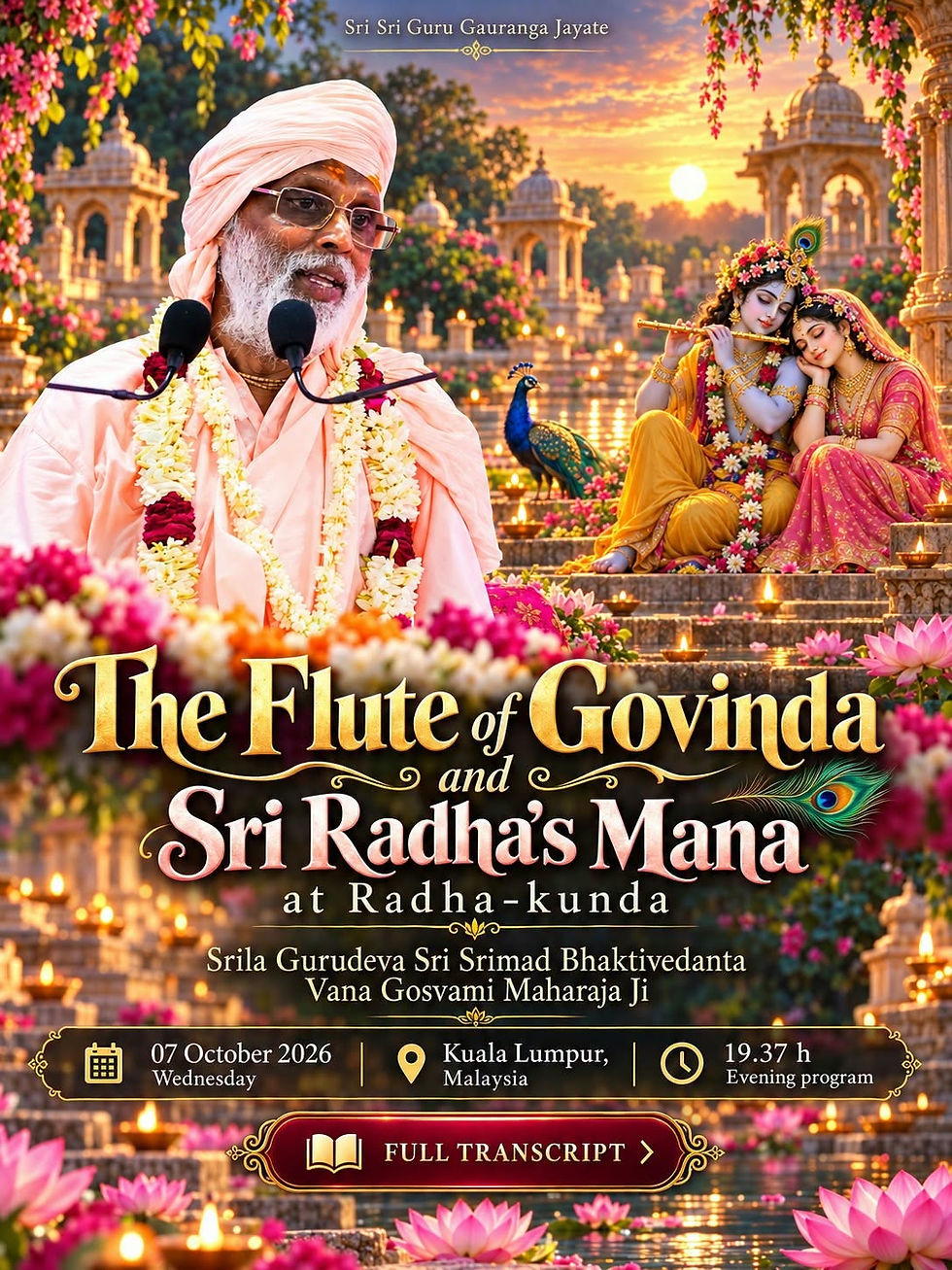
We are very lucky. Prabhuji [a devotee] also sang a very nice and beautiful song composed by Srila Jayadeva Gosvami in his Gita-govinda: dhira-samire yamuna-tire vasati vane vana-mali. It is high philosophy, but only those who are rasika Vaishnavas, devotees who have knowledge of rasa (devotional mellows), can understand it. As Chaitanya-charitamrita says:
bujhibe rasika jana, nā bujhibe anya
(Sri Chaitanya-charitamrita, Adi-lila 4.232)
[Only those who know rasa will understand this. Others will not.]
Other people cannot understand. The need is also adhara, a container. You can accept everything according to your adhara. If you want to bring water, what do you need? A container. In the same way, you can understand rasa-madhurya, the sweetness of devotional mellows, according to your container. But this container is now completely full of material things. I am not saying you have no container, but you have to clean it, inside and outside.
For this reason Lord Chaitanya Mahaprabhu said, “Just chant the holy names.” By regularly chanting the holy names your heart will become neat and clean. This is the process: associate with sadhus (sadhu-sanga) and chant the holy names (nama-sankirtana), and then you will be qualified to realise these things.
Chaitanya Mahaprabhu did not actually write any grantha (book). He only recited eight verses and glorified the holy names. This is nama-mahatmya, the glory of the holy name, and it is called Shikshashtakam. The verses are very nice.
ceto-darpaṇa-mārjanaṁ bhava-mahā-dāvāgni-nirvāpaṇaṁ
śreyaḥ-kairava-candrikā-vitaraṇaṁ vidyā-vadhū-jīvanamān
andāmbudhi-vardhanaṁ prati-padaṁ pūrṇāmṛtāsvādanaṁ
sarvātma-snapanaṁ paraṁ vijayate śrī-kṛṣṇa-saṅkīrtanam
(Sri Shikshashtakam 1 / Bhajana-rahasya 1.11)
[Let there be supreme victory for the chanting of the holy name of Sri Krishna, which cleanses the mirror of the heart and completely extinguishes the blazing forest fire of material existence. Sri-krishna-sankirtana diffuses the moon rays of bhava, which cause the white lotus of good fortune for the jivas to bloom. The holy name is the life and soul of Divya Sarasvati who reveals divine knowledge in the devotees’ hearts. It continuously expands the ocean of transcendental bliss, enabling one to taste complete nectar at every step, and thoroughly cleanses and cools everything, both internally and externally, including one’s body, heart, self (atma) and nature.]
By regularly chanting the holy names you can clean your heart. If a container is full of mud, how can you fetch water in it? First clean the pot and take out the mud and everything. Then you can bring the water. This is also a process. In the same way, the heart of the conditioned soul (baddha-jiva) is completely full of anarthas, unwanted things. How many types of anarthas are there in the heart of the conditioned soul? There are four.
The first is svarupa-bhrama, illusion about your own transcendental constitutional form.
The second is asat-trishna. Trishna means thirst. When you are thirsty, you want water and you drink it. Asat-trishna is thirst for what is asat, which is not true, but you think it is true. It is hankering to collect material sense gratification. In this material world the conditioned souls have so many kinds of asat-trishna.
The third is hridaya-daurbalya, weakness of the heart. Because of this weakness, lust, anger and envy come.
The fourth is aparadha, offenses: nama-aparadha, dhama-aparadha, seva-aparadha and Vaishnava-aparadha. There are four types of offenses. The first is nama-aparadha, and there are ten kinds of it. If you want to chant the holy names, you have to consider the ten offenses against the holy name.
The first is satam ninda: never criticize any sadhu. The second is that you should never think that the name of Krishna is equal to the name of Shiva. Krishna is the Supreme Personality of Godhead, Bhagavan.
Krishna Is Svayam Bhagavan and His Four Unique Sweetnesses
ete cāṁśa-kalāḥ puṁsaḥkṛṣṇas tu bhagavān svayam
(Srimad-Bhagavatam 1.3.28)
[All avataras such as Sri Ramachandra and Nrisimhadeva are the plenary portions, or expansions of the plenary portions, of the Supreme Personality of Godhead. However, Sri Krishna is Svayam Bhagavan, the embodiment of six opulences and the original fountainhead of everything.]
Srimad-Bhagavatam gives the evidence. Always think that Krishna is Svayam Bhagavan. One is called Bhagavan and another is called Svayam Bhagavan. Krishna, Vrajendra-nandana Shyamasundara, is Svayam Bhagavan.
In the Gaudiya siddhanta this is analyzed a little more deeply. We say Krishna, but one is called Vrajendra-nandana Krishna, another is called Mathuradhisha Krishna, and another is called Dvarakadhisha Krishna. Krishna is one, this is true. But according to rasa-vichara, the consideration of rasa, the first is Vrajendra-nandana Shyamasundara, Vrindavana Krishna. Then there is Mathuradhisha Krishna, and third is Dvarakadhisha Krishna. When you come into the Gaudiya line, you will analyze these things deeply.
So Svayam Bhagavan is Vrajendra-nandana Shyamasundara, Yashoda-nandana, Nanda-nandana Krishna, who is also called dhira-lalita nayaka (the playful hero). Brahma, Shiva and all the demigods and goddesses pay their obeisances at the lotus feet of Vrajendra-nandana Shyamasundara. His form is beautiful and attractive. He is Dvibhuja Muralidhara Shyamasundara. Dvibhuja means He always manifests two arms, and Muralidhara means He plays the flute.
He has sixty-four qualities, but four of them are unique and unparalleled. The first is rupa-madhurya, the sweetness of His beauty. The second is lila-madhurya, the sweetness of His divine pastimes. The third is prema-madhurya, the sweetness of His divine love. And the fourth is venu-madhurya, the sweetness of the sound of His flute. Govinda venu-dhari.
The Sweetness of Govinda’s Flute and the Love of Vrindavana’s Trees
Shukadeva Gosvamipada said that when Krishna plays the flute, everybody’s heart becomes completely intoxicated. Everybody starts to dance and is captivated by the sound of the flute. This is Govinda-venu.
kā stry aṅga te kala-padāyata-veṇu-gīta-
sammohitārya-caritān na calet tri-lokyām
trailokya-saubhagam idaṁ ca nirīkṣya rūpaṁ
yad go-dvija-druma-mṛgāḥ pulakāny abibhran
(Srimad-Bhagavatam 10.29.40, Pranaya-gita)
[Dear Krishna, what woman in all the three worlds wouldn’t deviate from religious behavior when enchanted by the melodious, drawn-out melody of Your flute? Your beauty makes all three worlds auspicious. Indeed, even the cows, birds, trees and deer manifest the ecstatic symptom of bodily hair standing on end when they see Your beautiful form which makes all three worlds auspicious.]
Go means the cows of Vrindavana. Dvija means the birds, all the birds of Vrindavana. They come very close to Krishna.
vṛndāvanaṁ sakhi bhuvo vitanoti kīrtiṁ
yad devakī-suta-padāmbuja-labdha-lakṣmi
govinda-veṇum anu matta-mayūra-nṛtyaṁ
prekṣyādri-sānv-avaratānya-samasta-sattvam
(Srimad-Bhagavatam 10.21.10, Venu-gita)
[O sakhi Radha, this Vrindavana is spreading the fame of the Earth planet even above that of Vaikuntha because it is splendidly decorated by the marks of the lotus feet of Yashodanandana Sri Krishna. Sakhi, when rasikendra Sri Krishna plays on His murali, which enchants the whole world, the peacocks become intoxicated and, thinking the sound of the flute to be the roaring thunder of the clouds, spread their tail feathers and begin to dance. Seeing this, the birds and animals roaming in the meadows of Govardhana become completely stunned and relish the sound of the flute with their ears and the dance of the peacocks with their eyes.]
This Venu-gita is very nice and beautiful.
prāyo batāmba vihagā munayo vane ’smin
kṛṣṇekṣitaṁ tad-uditaṁ kala-veṇu-gītam
āruhya ye druma-bhujān rucira-pravālān
śṛṇvanti mīlita-dṛśo vigatānya-vācaḥ
(Srimad-Bhagavatam 10.21.14, Venu-gita)
[O mother, the birds in this forest must be great sages. Sitting on the branches of beautiful trees, they close their eyes and silently listen to Krishna’s enchanting flute song.]
All the birds and deer, and even the cows, come very close to Krishna, and all of them become intoxicated with Krishna.
Not only this, even the rivers of Vrindavana, Manasi-ganga and the Yamuna, are affected. When Krishna plays the flute, the waves of the Yamuna also start to dance, up and down. The water comes down and then stops flowing, and it forms a waterfall.
nadyas tadā tad upadhārya mukunda-gītam
āvarta-lakṣita-manobhava-bhagna-vegāḥ
(Srimad-Bhagavatam 10.21.15)
[Hearing the song of Mukunda, the rivers had their flow broken by whirlpools that showed the rise of love in them, and with arms of waves they embraced the feet of Murari.]
How sweet is the sound of the flute of Govinda! With the go-dvija-druma, druma means the trees of Vrindavana. See how much love and affection they have for Krishna.
vana-latās tarava ātmani viṣṇuṁ
vyañjayantya iva puṣpa-phalāḍhyāḥ
praṇata-bhāra-viṭapā madhu-dhārāḥ
prema-hṛṣṭa-tanavo vavṛṣuḥ sma
(Srimad-Bhagavatam 10.35.9)
[The trees and creepers in the forest respond by becoming so luxuriant with fruits and flowers that they seem to be manifesting Lord Vishnu within their hearts. As their branches bend low with the weight, the filaments on their trunks and vines stand erect out of the ecstasy of love of God, and both the trees and the creepers pour down a rain of sweet sap.]
When Krishna comes to Vrindavana, all the trees show their love and affection for Him. What to say of the other living entities, the trees, mountains and rivers? When Krishna comes very close to the trees, they embrace Him with their long hands, which means their branches. It is like friends meeting after a long separation. In the same way, the trees of Vrindavana embrace Krishna with their branches. The leaves fan Krishna, because the trees think, “Oh, Krishna is now feeling so much heat.” The fruit trees come very close to Krishna and offer fruits and flowers to Govinda.
Not only this, the trees also make a very nice and beautiful carpet all over Vrindavana. The petals fall down like snow. The petals of different colors look like a beautiful, colorful and soft carpet. Can you believe it? Why do they have so much love and affection for Krishna? They welcome Krishna with their flowers.
Vishvanatha Chakravartipada gives an example. When a bona fide guru comes to the house of a bona fide disciple, and the disciple is also bona fide, what does the disciple do? A bona fide disciple is one who has completely and absolutely surrendered at the lotus feet of his guru and knows all the tattva-siddhanta. He welcomes his Gurudeva with flowers and flower petals. In the same way, the trees of Vrindavana show their love and affection for Krishna.
svāgatam, svāgatam, svāgatammama
mana-mandire raho niśi-din, kṛṣṇa murāri, kṛṣṇa murāri
(Mama Mana Mandire by Srila Bhaktivinoda Thakura)
[Welcome, welcome, welcome! O Krishna, O Murari, please stay day and night in the temple of my heart.]
Arati habe tomara prema-pradipe. I will do a very nice arati (an offering of a ghee lamp) with the lamp of prema, divine love. And I will say, svagatam, svagatam, svagatam. Hey Krishna, hey Murari, always stay in the temple of my heart, hridaya-mandira.
See how much love and affection they have. They also think that Krishna’s feet are very soft. Krishna’s feet are called ratula-charana, very soft and reddish. As I explained, when Krishna steps with one foot and then the other, it looks as if blood is dropping. This means His feet are very soft and reddish. You cannot imagine how beautiful the lotus feet of Govinda are.
So the trees think: how will Krishna walk on the path of Vrindavana, where there are many kinds of thorns and sharp grass and pebbles (nukila patthar)? For this reason the trees make a very nice, soft carpet with the petals of their flowers, so that Krishna can walk. This is called love and affection. What does love mean? Love means having mamata, possessiveness, in the heart. Our shastras give the definition of love. Try to understand this.
ananya-mamatā viṣṇau mamatā prema-saṅgatā
bhaktir ity ucyate bhīṣma-prahlādoddhava-nāradaiḥ
(Sri Bhakti-rasamrita-sindhu 1.4.2; Chaitanya-charitamrita, Madhya-lila 23.8)
[When one develops an unflinching sense of ownership or possessiveness in relation to Lord Vishnu, or, in other words, when one thinks Vishnu and no one else to be the only object of love, such an awakening is called bhakti [devotion] by exalted persons like Bhishma, Prahlada, Uddhava and Narada.]
Ananya means one-pointed with Krishna, na anya. Their mind is always absorbed in Krishna. Mamata means love and affection, so much possessiveness toward Krishna. This is called prema. In this way the trees think, and when Krishna comes very close, they fan Him with their leaves and cool Him. Krishna becomes very happy. Then they think, “Maybe Krishna is very hungry,” and they offer Him very nice, juicy fruits. The flowers blossom and a sweet fragrance comes, as in the song Aja braja mem holi re rasiya, which the Vrajavasis sing. Many kinds of flowers of different colors blossom, and when they fall they color everything everywhere in different colors.
They do this because they have love and affection. Why? Because they think, “Our Prana-Govinda has come.” I will give an example. When a special guest comes, you decorate your house very nicely, with a nice carpet and everything. When a prime minister, a president or other very aristocratic people come, we decorate very nicely, with nice asanas and simhasanas (seats and thrones). In the same way, in Vrindavana the trees prepare everything. Yogamaya arranges it in this way.
yat kiñcit tṛṇa-gulma-kīkaṭa-mukhaṁ goṣṭhe samastaṁ hi tat
sarvānandamayaṁ mukunda-dayitaṁ līlānukūlaṁ param
śāstrair eva muhur muhuḥ sphuṭam idaṁ niṣṭaṅkitaṁ yācñayā
brahmāder api sa-spṛheṇa tad idaṁ sarvaṁ mayā vandyate
(Srila Raghunatha dasa Gosvami, Stavavali, Vraja-vilasa-stava 102)
[The grass, bushes, insects, and other creatures in Vraja are all very dear to Lord Krishna. They assist the Lord in ways favorable for His pastimes. They are filled with all varieties of transcendental bliss. (Again and again the scriptures recount the earnest request of Brahma and others to reside in Vraja in the form of an animal, a tree, a bush or a stone.) For these reasons I vow to offer my respects to all the living entities who reside in Vraja.]
Even in Vrindavana, all the insects, even snakes, spiders and scorpions, have so much love and affection for Krishna. Mukunda-dayitam, they are dear to Mukunda. They all help Radha and Krishna to meet together. Lilanukulam, they are favorable for the lila. In the transcendental Goloka Vrindavana there is nothing pratikula, unfavorable. Everything is favorable for Krishna-seva.
In this material world, if you see a snake you will be afraid. But in the transcendental world, Goloka Vrindavana, the snake and the cobra are also favorable for Krishna-seva. Now one question comes. How is it possible that a snake, a spider or a cobra is in the transcendental world, Goloka Vrindavana? Actually, Yogamaya herself manifests the different types of insects and snakes. Why? For Krishna-seva, Govinda-seva.
Three Stages of Dhama and the Finding of Radha-kunda
Let me give an example so that you may understand. In Goloka Vrindavana, the transcendental world, on the bank of Radha-kunda. Radha-kunda is there, in the aprakata Goloka Vrindavana. Actually, Radha-kunda is in the transcendental world, Goloka Vrindavana. Then Krishna with His Yogamaya manifested it in this material world.
śrī-kṛṣṇa-caitanya prabhu jīve doyā kori’
swa-pārṣada swīya dhāma saha avatari’
atyanta durlabha prema koribāre dāna
śikhāya śaraṇāgati bhakatera prāna
(Sri Krishna Chaitanya Prabhu Jive Doya Kori, verse 1, Sharanagati
by Srila Bhaktivinoda Thakura)
[Out of mercy to the conditioned souls, Lord Sri Krishna Chaitanya descended together with His eternal associates and His own abode. He came to bestow the exceedingly rare gift of divine love for Krishna and to teach the process of surrender, which is the very life of the devotees.]
He manifested everything from Goloka Vrindavana. We try to understand this philosophy, this tattva. There are three types of dhama: drishyamana-prakasha, prakata and aprakata-dhama.
Now we are going to Radha-kunda and Shyama-kunda. You can see that the place is there, but you cannot see the lila. The place is there, Giriraja Govardhana is there, and five thousand years ago Krishna manifested His lila in Vraja. The same places are there. Giriraja Govardhana, Radha-kunda, Shyama-kunda, everything is there, but you cannot see the lila. This is called drishyamana-prakasha. The place is there, but you cannot see the lila. Those who are exalted, uttama-uttama maha-bhagavatas, when they are absorbed in feeling separation, sometimes Yogamaya may manifest the lila in front of them. Otherwise not. So Bhaktivinoda says:
dekhite dekhite, bhulibo vā kabe,
nija-sthūla-paricoya
nayane heribo, braja-pura-śobhā,
nitya cid-ānanda-moya
(Dekhite Dekhite, verse 1
by Srila Bhaktivinoda Thakura)
[When, before my very sight, will my bodily self-conception disappear? Then, with my own eyes I shall behold the exquisite beauty of Vraja, full of eternal spiritual cognizance and bliss.]
When we completely forget our material bodily conception, then by the causeless mercy of Krishna we realise our transcendental body. All our transcendental limbs and body come. Then we can see how beautiful the transcendental dhama, Vraja-dhama, is.
vṛṣabhānu-pure, janama la-iba,yāvaṭe vivāha ha’be
[I will take birth in Vrishabhanu-pura, and I will be married in Yavata.]
Prabhuji also sang:
yamunā-puline, kadamba-kānane,
ki herinu sakhī! āja
śyāma vaṁśī-dhārī, maṇi-mañcopari,
kare līlā rasa-rāja
kṛṣṇa-keli sudhā-prasravaṇa
aṣṭa-dalopari, śrī rādhā śrī hari,
aṣṭa-sakhī parijana
(Yamuna Puline, verses 1–2
by Srila Bhaktivinoda Thakura)
[O friend, what did I see today on the bank of the Yamuna, in the forest of kadamba trees? Shyama, the flute-player, on a jeweled throne, performs the pastimes of the king of rasa, a flow of nectar from Krishna’s sports. On the eight-petaled lotus are Sri Radha and Sri Hari, with the eight sakhis around Them.]
sugīta-nartane, saba sakhī-gaṇe
tuṣiche yugala-dhane
kṛṣṇa-līlā heri’, prakṛti-sundarī
vistāriche śobhā vane
(Yamuna Puline, verse 3
by Srila Bhaktivinoda Thakura)
[By singing sweet songs and dancing gracefully, all the sakhis satisfy their treasured Divine Couple. Beholding Krishna’s pastimes, the beautiful spiritual energy expands the splendor of the Vrindavana forest.]
Prabhuji is singing very nicely and beautifully, according to the rhythm. The heart melts automatically. In the same way, when the sadhaka comes to the stage of bhava-dasha, at that time Yogamaya will manifest the very nice and beautiful Vrindavana. How beautiful Vrindavana-dhama is! Now you cannot see the transcendental Vrindavana. First there is drishyamana-prakasha. You can see the place where Krishna, Srimati Radhika, the gopas and the gopis performed this lila. The place is there, and the spot is there, but you cannot see it.
What to say of us? When Lord Chaitanya Mahaprabhu came to Vrindavana-dhama, at that time Vrindavana was completely full of dense forest. Many ferocious animals, tigers, lions and snakes, were there. It was completely a jungle. Lord Chaitanya Mahaprabhu came to Vrindavana and asked the Vrajavasis, “I heard from Srimad-Bhagavatam that Krishna killed one demon called Arishtasura. For this reason that village is called Aritgaon. Here were also Radha-kunda and Shyama-kunda. But where are Radha-kunda and Shyama-kunda?” No one gave any answer, because people did not know where Radha-kunda and Shyama-kunda were.
Now it is very easy for us to take darshana. It is very nice and beautiful. We look at this Radha-kunda, take bath and go this way. But 500 years ago, when Lord Chaitanya Mahaprabhu came, no one knew where Radha-kunda and Shyama-kunda were. Mahaprabhu found this place, and then Raghunatha dasa Gosvami very nicely manifested it.
Mahaprabhu came to one place and asked a very old Vrajavasi, maybe 90 years old, “Hey Baba, please tell me where Radha-kunda and Shyama-kunda are.” He said, “We don’t know, but here is a rice field.” You know dhana-kheta? That is a rice field. In the rice field there were two small kundas. One is called Gauri-kheta and the other is called Kali-kheta. The people knew only that a small kunda was there. At that time Chaitanya Mahaprabhu took bath in Gauri-kheta, and He declared, “This is Radha-kunda.” Actually, this place was completely manifested by Lord Chaitanya Mahaprabhu, Shachinandana Gaurahari. Then Chaitanya Mahaprabhu took bath in the other small kunda, called Kali-kheta, and declared, “This is Shyama-kunda.” So there are Radha-kunda and Shyama-kunda. Look at this. Just 500 years ago the people had completely forgotten, and 5,000 years ago Krishna performed rasa and all these lilas. Who knows?
So now we are going to Vraja-mandala, the place called drishyamana-prakasha. Then there is prakata-lila, when Krishna descends from Goloka Vrindavana with His own parikara (associates) and performs His lila. Krishna does not come every day, not every time, not every yuga. He comes once in a day of Brahma. One day of Brahma means 1,000 catur-yugas: Satya, Treta, Dvapara and Kali. This cycle rotates 1,000 times. At the end of a Dvapara-yuga, Krishna comes with His parikara as Vrajendra-nandana Shyamasundara. When Krishna performs His sweet lila, that is called prakata-lila.
Then there is aprakata Goloka Vrindavana, the transcendental world, where Radha-kunda and Shyama-kunda are also there. Only nitya-lilas, eternal pastimes, are going on there. Very nice and beautiful lilas are going on. So we try to understand the three stages of dhama: drishyamana-prakasha, prakata and aprakata Goloka Vrindavana.
Srimati Radhika’s Mana at Radha-kunda
Now we come to the aprakata Goloka Vrindavana, the transcendental world. Radha-kunda and Shyama-kunda are there also, a very nice and beautiful place. Srimati Radhika and Krishna meet each other in the middle of Radha-kunda and Shyama-kunda. That place is called sangama-sthala, the meeting place of love and affection, where Radha-kunda and Shyama-kunda meet together. A very nice and beautiful meeting is going on, with laughing and so on. Then suddenly Srimati Radhika’s mana comes.
Do you understand mana? It is anger. Mana comes, and this is called ahaituki mana, anger without any reason. Srimati Radhika becomes very angry. Then She leaves Krishna and goes to the other side of the bank of Radha-kunda. For this reason Sri Prabodhananda Sarasvatipada says:
yasyāḥ kadāpi vasanāñcala-khelanottha-
dhanyātidhanya-pavanena kṛtārtha-mānī
yogīndra-durgama-gatir madhusūdano ’pi
tasyā namo ’stu vṛṣabhānu-bhuvo diśe ’pi
(Sri Radha-rasa-sudha-nidhi, verse 2
by Srila Prabodhananda Sarasvati)
[Let us bow down even to the direction of the land of Vrishabhanu Maharaja, for Madhusudana Krishna, who is the rarely attained goal of great yogis, considers that His life is completely fulfilled by the mere touch of that glorious, playful breeze that has touched the tip of Srimati Radhika’s garment. He thinks, “Oh, My life has now returned.”]
Vrishabhanu-nandini Srimati Radhika, the daughter of Vrishabhanu Maharaja, is now on the other side of Radha-kunda, and Krishna is on the opposite side. Srimati Radhika is very angry. Now Krishna thinks, “What to do?” So Prabodhananda says, dhanyatidhanya-pavanena kritartha-mani. Krishna says, “Hey Pavana-deva [the wind god], your life is successful because you are now playing with the cloth of Srimati Radhika.” The wind blows, and the cloth of Srimati Radhika lifts up and down, and a sweet fragrance comes toward Krishna.
So He says, yogindra-durgama-gatir madhusudano ’pi. Krishna is not an ordinary person. He is the Supreme Personality of Godhead, Svayam Bhagavan. But now He is doing this lila like a human being, and He is completely controlled by Srimati Radhika. He looks like a lusty person. Krishna is not lusty, but He looks lusty, and He is completely controlled by Srimati Radhika. For this reason Krishna says, tasya namo ’stu vrishabhanu-bhuvo dishe ’pi. Now Krishna is thinking what He will do.
How can He break the mana of Srimati Radhika? Krishna’s best weapon is the flute. In Vrindavana, Krishna keeps the flute. Why? To break the mana of the gopis. Gopi-mana-bhanjana kana-keli. Not only this, with His flute He also calls the gopis. Understand:
rādhe rādhe bali’, muralī ḍākibe,madīya īśvarī-nāma
(Gita-mala, Siddhi-lalasa, song 5, verse 4
by Srila Bhaktivinoda Thakura)
[Calling “Radhe, Radhe,” the flute will call out the name of my mistress.]
Radha-kunda katha is very nice. I am just mentioning it to you.
cintāmaṇi-maya, rādhā-kuṇḍa-taṭa,
tāhe kuñja śata śata
prabāla-vidruma-maya taru-latā,
muktā-phale avanata
(Gita-mala, Siddhi-lalasa, song 5, verse 1
by Srila Bhaktivinoda Thakura)
[The bank of Radha-kunda is made of chintamani jewels, and there are hundreds and hundreds of groves. The trees and creepers are made of coral and gems, and they bend low with fruits of pearls.]
This is a very nice and beautiful song by Bhaktivinoda Thakura, Kamala-manjari. So now Krishna played the flute, because He had to break the mana of Srimati Radhika.
niśāmya gītaṁ tad-anaṅga-vardhanaṁ vraja-striyaḥ kṛṣṇa-gṛhīta-mānasāḥ
ājagmur anyonyam alakṣitodyamāḥ sa yatra kānto javalola-kuṇḍalāḥ
(Srimad-Bhagavatam 10.29.4)
[When the young women of Vrindavana heard Krishna’s flute song, which arouses Cupid within the heart, their minds were absorbed in thoughts of the Lord. They went to where their lover waited, each unknown to the others, moving so quickly that their earrings swung back and forth.]
Shukadeva Gosvamipada told Parikshit Maharaja that when Krishna played the flute, all the gopis gave up their household duties. They gave up all kinds of lajja (shyness) and mana, and they ran toward Krishna. Krishna plays the flute to attract people toward Him. So now Krishna played the flute, thinking, “I have to break the mana of Srimati Radhika.”
And Srimati Radhika, in Her mana, is going to Yavata. “Well, no, I will not stay here. I have to go back to My home.” Srimati Radhika is going, and then Krishna plays the flute. The sound of the flute is very powerful. No one can escape from the sound of the flute of Govinda, venu-dhari.
When Krishna plays the flute, Srimati Radhika thinks, “I will not listen to the sound of the flute.” So She puts some cotton tightly inside Her ears. Then Krishna thinks, “Oh my God, what to do now?” It is another problem. Srimati Radhika thinks, “I will not listen to the sound of the flute of Govinda, venu-dhari.” Here it says, nishamya gitam tad ananga-vardhanam vraja-striyah krishna-grihita-manasah. Srimati Radhika thinks, “If I listen, then a problem will come.” Do you understand? If you listen to the sound of the flute, you will return to Krishna. This is the process. But Srimati Radhika is thinking, “Now I will not listen.” That is why She puts cotton inside Her ears, tightly. Then Krishna thinks, “What to do now?” Lokavat tu lila-kaivalyam, He acts like a human being. Then Krishna thinks, “My brahmastra has completely failed.” Then Krishna remembers Yogamaya.
bhagavān api tā rātrīḥ śāradotphulla-mallikāḥ
vīkṣya rantuṁ manaś cakre yogamāyām upāśritaḥ
(Srimad-Bhagavatam 10.29.1)
[Sri Krishna is the Supreme Personality of Godhead, full in all opulences, yet upon seeing those autumn nights scented with blossoming jasmine flowers, He turned His mind toward loving affairs. To fulfill His purposes He employed His internal potency, Yogamaya.]
At the beginning of the rasa dance Shukadeva Gosvamipada said, bhagavan api ta ratrih sharadotphulla-mallikah vikshya rantum manash chakre yoga-mayam upashritah. Krishna performs all His lila with His Yogamaya. So Krishna thinks, “Hey Yogamaya, You help Me.” Just remember:
lokavat tu līlā-kaivalyam
(Vedanta-sutra 2.1.33)
[The creation is merely a play of the Lord.]
Krishna performs this lila as a human being, manava-lila.
So Krishna remembers Yogamaya. Now Srimati Radhika is going back to Her house in Yavata. But this path of Vraja is a very narrow place. Only one person can go. If another person comes from the opposite way, it is very difficult to cross, because on both sides there are many bushes and thorns. The path of Vraja is very small, and only one person can go. So Srimati Radhika is going, and then Krishna remembers Yogamaya. Yogamaya manifests in the form of a cobra snake. Look at this. The cobra comes from the opposite way toward Srimati Radhika.
The cobra is very long and wide, and it raises its hood. Its two eyes are red like blood, and it has fangs like this. When Srimati Radhika sees that it is a cobra, and hears it making the sound sshh, sshh, She is afraid. She cannot go to the left side, and She cannot go to the right side. What can She do? She has to go back. But the cobra is coming from that side also. Yes, the cobra is coming. Then Srimati Radhika is afraid, and She comes very close to Krishna.
“Krishna, Krishna, maha-baho! Raksha mam, raksha mam.” Hey Krishna, hey mighty-armed one, please protect Me. Then Srimati Radhika embraced Krishna, and Radha and Krishna met together. Then Srimati Radhika’s mana was automatically broken. Bolo Vrindavana Bihari Lal ki jaya! Then all the sakhis, Lalita, Vishakha and the others, sang the arati:
jaya jaya rādhā-kṛṣṇa yugala-milanaāratī karowe lalitādi sakhī-gaṇa
(Sri Yugala-arati, Gitavali, Arati-kirtana 3
by Srila Bhaktivinoda Thakura)
[All glories, all glories to the meeting of Radha and Krishna. Lalita and the other sakhis perform the arati.]
Date: 07 October 2026 Location: Kuala-lumpur, Malaysia


Comments